

Many executives are asking themselves lately, “Why is leadership so hard?” If you feel the weight of the role increasing, you’re not alone.
There are few jobs that are more difficult than leading others. Leaders have always had a lot they needed to do well, from skills and behaviors and relationships and ethical dilemmas. They need not just smarts but also heart. Plus, a healthy mindset and strong doses of emotional intelligence and resilience. On top of all that, leaders today are operating in an environment of astonishingly rapid change, rising expectations, and wicked complexity. Talk about challenging.
If leadership sounds and feels harder than ever, it’s not your imagination. And it’s not just you.
Given this demanding environment, it’s no surprise that CEO turnover is surging, according to executive outplacement firm Challenger, Gray & Christmas. Consider the following:
- In 2024, 373 CEOs of public companies stepped down—an increase of 24% from 2023.
- Across U.S. companies with at least 25 employees, 2,221 CEOs exited last year, the highest total since the firm began tracking departures in 2002.
- Roughly one in nine CEOs was replaced last year across 1,500 of the largest publicly traded firms, according to a new analysis—the highest turnover rate since 2010.
That means we have a whole new crop of leaders taking the helm at a time of great challenge and peril. How well prepared are they? There’s reason for concern.
According to the Glenn Llopis Group 2025 white paper, “Transforming Leadership in the Age of Personalization”:
- 69% of leaders report being uncertain about their current roles
- 79% of leaders strongly agree they are not reinvention-ready as individuals
- Only 41% of executives report having a strong consensus on how to evolve their company’s business model

Why Leadership Is So Hard Now: The 5 Pressure Points
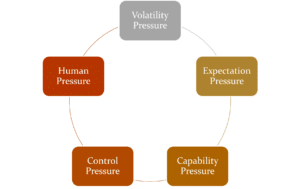
Leaders today face five leadership pressure points—forces that are converging on them and intensifying the demands of the role. As a leader, you can’t eliminate these pressures, but you can learn to handle them.
1. Volatility Pressure: You’re leading on frequently shifting ground.
- You’re navigating disruption from artificial intelligence that’s reshaping roles, decisions, and strategy at an astounding pace.
- You’re dealing with geopolitical and macroeconomic instability, including wars, supply disruptions, trade tensions, and market volatility.
- You’re operating in a market landscape that’s increasingly unpredictable.
- You’re finding that traditional leadership playbooks no longer work as effectively as they once did.
- You’re having to adapt to rapid structural changes, such as hybrid work and flatter organizations.
Can you lead with clarity and conviction in a world that won’t hold still?
2. Expectation Pressure: The bar keeps rising—and pulling you in different directions.
- You’re facing higher expectations from boards, workers, customers, and society than ever before.
- You’re expected to have answers and provide direction even when things are messy and muddled.
- You’re responsible for so many things, including financial results, worker morale and performance, customer relations, culture building, planning, change and crisis management.
- You’re expected to be fair, transparent, supportive, and caring—while also being decisive and results-driven.
- You’re expected to create psychological safety within your team or organization.
- You’re operating in an environment in which boards are quicker to replace leaders who don’t meet rising and changing expectations.
- You’re navigating contradictory demands, such as being both bold and humble at the same time.
How to handle it when you’re expected to be everything, for everyone, all at once?
3. Capability Pressure: You’re expected to excel at skills you may have never learned.
- You may have stepped into leadership without effective training or adequate preparation—or you received training that didn’t match the realities of the role.
- You’re expected to give effective feedback, even if you were never taught how to do it well.
- You must delegate effectively while still maintaining accountability.
- You’re expected to address conflict constructively.
- You must manage performance and hold people accountable.
- You’re expected to prioritize effectively amid constant and competing demands.
- You need to reinvent yourself continuously to keep up with change.
How to perform at a high level while learning critical skills on the fly?
4. Control Pressure: You’re accountable for outcomes you don’t fully control.
- You’re facing challenges that are largely outside your control, yet you’re still responsible for the results.
- You’re making frequent high-stakes decisions with incomplete information.
- You may be operating with limited support relative to the scope of your responsibilities.
- You’re feeling the pressure of being accountable for strong outcomes in an increasingly complex and confounding context.
How to get excellent results in a chaotic environment with wicked complexity and breakneck change?
5. Human Pressure: The weight of leadership is massive.
- You’re operating under constant pressure and are no stranger to deep, grinding frustration.
- You struggle to keep up with the blistering pace of change.
- You face intense scrutiny from multiple stakeholders, each with their own demands.
- You’re experiencing the exhausting emotional weight that comes with leadership.
- You find it difficult to fully switch off, given the incessant demands on your time and attention.
- You’re struggling to navigate the competing demands of work and your personal life.
- You’re fending off executive burnout.
How to carry the weight of leadership when you have no place to set it down?

There you have it: the five leadership pressure points challenging leaders today. See the image below.
The natural question, then, is what you can do about these 5 leadership pressure points. Here we address 5 responses to address the pressure points.
+++++
The 5 Responses to the Leadership Pressure Points
In physics and engineering, highly pressurized systems don’t typically survive by eliminating pressure. They survive by managing it. They’re built with pressure relief valves: mechanisms that release excess pressure before it reaches dangerous levels.
Leadership works the same way. The pressure points aren’t going away. But the leaders who sustain performance over time are the ones who build their own relief valves—practices that prevent pressure from building to a breaking point. Here are the five responses to the leadership pressure points:
Response 1: Address Volatility Pressure with Adaptive Clarity
You can’t control the pace of change, but you can create clarity within it. Shift your focus from needing certainty to creating direction amid uncertainty. Action items:
- Simplify complexity so your team knows what matters most right now. Share your thinking out loud: Let people see how you’re making decisions in uncertainty.
- Set clear priorities even when the future is unclear. Name the top-three priorities weekly. Force clarity by explicitly stating what matters most right now.
- Communicate direction as “best current thinking,” not false certainty. Regularly address what’s changed and what hasn’t.
- Adjust quickly without being erratic or reactive. Use shorter planning cycles: Shift from annual to quarterly or sprint-based thinking. (See our article, “Ditch Frozen Structures for Tiger Teams.”)
Response 2: Address Expectation Pressure with Intentional Alignment
You can’t meet every expectation, so you must prioritize, align, and set boundaries. Shift your focus from trying to satisfy everyone to aligning key stakeholders around what matters most. Action items:
- Clarify what success actually looks like—and what it doesn’t. Define success in one sentence: “This quarter, success means X, Y, Z.”
- Resist the pressure to be everything to everyone. Say what you are not prioritizing—and why.
- Manage expectations proactively instead of reacting to them. Reset expectations before misalignment compounds.
- Name trade-offs explicitly and enlist your team’s support in navigating them.
Response 3: Address Capability Pressure with Deliberate Skill-Building
You don’t need to know everything—but you do need to close your most critical gaps. Focus on continuously upgrading your leadership toolkit. Action items:
- Identify the top leadership skills that matter most in your role. Pick 1–2 skills to focus on per quarter: Avoid trying to improve everything at once.
- Actively build capability in areas like delegation, conflict, feedback. Ask for targeted feedback: “What’s one thing I could do better as a leader right now?”
- Seek coaching and feedback. Practice new skills in real time. Treat meetings as reps for skills like deep listening, asking better questions, and closing meetings with clarity (e.g., Okay, now who will do what by when?). Invest in coaching or peer learning.
- Treat leadership as a craft and a quest, not a position. Apply yourself diligently toward learning and personal development. Get crystal clear on what you’re seeking to do through your leadership. Where do you want to take your team or organization? What kind of organization are you trying to build (e.g., excellent, ethical, and enduring—what we call “triple crown leadership”)?
Response 4: Address Control Pressure with Focused Ownership
You can’t control everything—but you can be disciplined about what you “own” as your responsibility. Shift your attention to focused accountability and targeted influence.
- Distinguish between what you can control and influence versus what you must accept.
- Focus on making good (and quick) decisions with imperfect information. Define where you decide versus contribute. Make decisions with a ‘next best step’ mindset. Avoid the trap of waiting for perfect information.
- Avoid overextending into areas where you have little leverage.
- Take full ownership of your choices, even in chaotic and disorienting circumstances. Don’t deflect responsibility, even when results are messy.
Response 5: Address Human Pressure with Sustainable Self-Leadership
You can’t lead well if you’re feeling depleted. Shift your focus from constant output to managing your energy (not your time), as Tony Schwartz and Catherine McCarthy suggested in their classic Harvard Business Review article.
- Set boundaries to protect your personal capacity and focus. Set a non-negotiable boundary (e.g., no email after a certain hour).
- Build habits and systems that sustain you over the long term. Build a small support system (e.g., 2–3 people you can speak honestly with).
- Build rhythms that allow you to recover. Create end-of-day shutdown rituals and switch off mentally. Schedule recovery like you schedule meetings. Protect time to reset like an elite athlete.

Final Thoughts
You know deep down that these enhanced pressures of leadership aren’t going away. They’re part of the job today. No one said the privilege of leadership would be easy.
In the physical world, when stress on a material exceeds its capacity, it begins to deform. And eventually it breaks.
Leadership is no different. It’s not the presence of pressure that causes failure. It’s sustained pressure without adaptation or targeted release.
With the right mindset and approach, you can lead effectively in these chaotic and challenging times. The goal isn’t to eliminate the pressure points of leadership. It’s to build the capacity to handle and release that pressure before it breaks you and your organization. Ignore these leadership pressure points at your peril. If you address them diligently, you’ll see how you can thrive where few others can.
Wishing you well with it.
–Gregg

P.S. – Consider taking my Team Conflict Avoidance Quiz to make sure your team is addressing conflict effectively and not burying it under the sand.
Tools for You
- Leadership Derailers Assessment to help you identify what’s inhibiting your leadership effectiveness
- Personal Values Exercise to help you determine and clarify what’s most important to you
- Alignment Scorecard to assess your organization’s level of alignment and make plans for improving it
- Traps Test to help you determine what’s inhibiting your happiness and quality of life
Related Articles
- “How Leaders Should Address the Unique Challenges of Our Times”
- “Leading through Chaos and Uncertainty”
- “Ten Keys to Self-Leadership”
- “The Cost of Conflict Avoidance: A Leader’s Guide to Productive Conflict”
- “Great Leaders Prioritize Learning–Why and How”
- “How to Align Your Organization for Peak Performance”
- “Ditch Frozen Structures for Tiger Teams”
- “Synthesis: A Critical Leadership Skill”
- “Leadership and Psychological Safety in Teams”

+++++++++++++++++++++++
Gregg Vanourek is a writer, teacher, and TEDx speaker on leadership and personal development. He is co-author of three books, including Triple Crown Leadership: Building Excellent, Ethical, and Enduring Organizations (a winner of the International Book Awards written with his father, Bob Vanourek) and LIFE Entrepreneurs (a manifesto for living with purpose and passion). He has worked for market-leading ventures and given talks or workshops in 8 countries. Check out his Leadership Derailers Assessment or join his growing community. If you found value in this, please forward it to a friend. Every little bit helps!
1 thought on “Why Leadership Is So Hard Now: 5 Pressure Points”
These pressures can feel brutal for leaders.