

Article Summary:
Unexamined leadership imprinting means you may be unconsciously repeating the habits—good and bad—of the leaders who shaped you. This blog helps you bring those influences into focus and offers a practical worksheet and actionable checklist for becoming a more intentional, self-directed leader.
+++
As a leader, you may have spent years reading books, attending events, refining your skills, and gaining experience. Yet one of the biggest influences on your leadership style may have occurred long before any of that: the leaders you had at the beginning of your career. In short, what kind of leadership imprinting did you have?
What Is Imprinting?
In organizational theory, “imprinting” occurs during sensitive periods when you’re susceptible to the influence of prominent features of your environment and you keep acting that way long after things have changed. Many people point to the example of newly hatched ducklings and how they naturally follow the first thing they see.
Imprinting is a concept that dates back to the 1960s, and it can be applied to many areas. Here are some examples:
Family Imprinting. Think about the outsized influence of your parents on how you saw and experienced the world growing up. It’s likely that many of their influences persist—perhaps in traditions you’ve continued, or in frustrating or damaging approaches you’ve resisted. Think about the lasting effects of your childhood on the rest of your life, for good or ill.
Career Imprinting. Consider how your first jobs may have had lasting effects on you and how you view work, ambition, decision-making, culture, success, and more. Harvard Professor Monica Higgins has defined career imprinting as “the process by which individuals pick up or cultivate a certain set of capabilities, connections, confidence, and cognition due to their work experiences at a particular employer.” (1)
For example, your perspective could vary dramatically if you worked in management consulting or investment banking versus city planning or libraries. Your approach to work could vary widely if you served in the military or experienced the famous brand management system of Procter & Gamble, the zany antics of Southwest Airlines, the customer obsession of Amazon, the refined service of Ritz-Carlton, or the down-to-earth, values-based culture of Chick-fil-A. Your outlook can vary widely depending on whether your work environment was highly structured or informal, whether it was bureaucratic or entrepreneurial. In your formative years, did you work with brilliant and inspiring leaders or toxic narcissists and energy vampires?
Macroeconomic Imprinting. Consider how differently you might view savings, investment, and risk if you had grown up during the Roaring 20s versus the Great Depression.
Startup Founder Imprinting. According to researchers, startup founders and their mental models for how they approach decisions have lasting effects on a wide range of factors in organizations even after they’ve left the venture they started. (2)
Leadership Imprinting. Leadership imprinting is the lasting mark left by your earliest or most influential bosses. It explains why so many leaders manage people the way they were once managed—for better or worse—long after that approach stops working.
Negative Leadership Imprints
Unfortunately, in many cases the leadership imprinting you receive may be harmful.
Did you work for a micromanager or information hoarder? A conflict avoider? A command-and-control boss who meticulously avoided looking weak or vulnerable? (3)
Early in my career, I had a boss who was wicked smart, greatly accomplished, and sometimes charming and generous but could also be testy, cross, ornery, and petulant at times. It made me wonder about his own imprints, but there’s no doubt that his Jekyll and Hyde transformations summoned dark clouds over the office on many days.
I had another boss who was exceptionally bright and well connected but often haphazard in his approach to managing. This led to a work environment that was not just intense and demanding but also chaotic and even frenzied at times. It was exasperating to be in the middle of pursuing one idea and then be whipsawed into working on something else—all with manufactured urgency.
Early in his career, a friend of mine had a boss who was harsh and condescending. He would ream people for minor issues and revel in throwing people under the bus. When my friend and his coworker were being badly mistreated by a customer, their boss was quick to look the other way and show that all he cared about was the numbers.

Positive Leadership Imprints
Thankfully, some leadership imprinting you receive may be beneficial. (In most cases, it’s mixed.)
Early in your career, did you work for a manager who was exceptional at extending and earning trust? At not just delegating or empowering but also at unleashing people—giving them an automatic license to lead as long as they operated by the organization’s shared values? At holding people and teams accountable for ethical behavior as well as excellent results? A leader who was skilled not only at communication but also at giving, soliciting, and receiving feedback?
Early in my career, I had the good fortune of working for an organization with a board that was not only filled with influential and accomplished professionals but that also had a high degree of cordiality, with great warmth and mutual respect. And the organization was extraordinary at recognizing and celebrating the efforts and accomplishments of its people when they left.
I’m also grateful that early in my career, my managers gave me many opportunities to learn, grow, tackle challenges, and venture into a vast array of different domains as long as I continued delivering good results.
Here’s how my father and Triple Crown Leadership co-author, Bob Vanourek, described some of his positive leadership imprints:
“From an entrepreneur I briefly worked for, I learned about servant leadership and creativity. I learned about trusting people and creating cultures with lofty aspirations that touched people’s hearts and souls. From courageous colleagues and subordinates, I learned about the incredible gifts most people had that could be unleashed with great effect on the organization, the people around them, and themselves.”
After some frustrating work experiences that made him uncomfortable about the way he was expected to treat people (with aggressive downsizings after acquisitions), he had the chance to work for a kind, inspiring, and creative leader who turned him on to Robert Greenleaf’s framework of “servant leadership.” For my Dad, it was a “mind flip,” and it changed the trajectory of his career (and life). (5)
Have you had a leader who showed you that you’re worth investing in and not just a cog in the corporate machine? Did you have a leader who gave you the gift of clarity around expectations while also giving you the space to fail and learn from it? Did you have leaders who, even though they were busy and pressed, took the time to get to know you while also helping see your strengths and potential, not just your weaknesses and blind spots? That was the fortunate experience of a friend of mine.
Worksheet: Examining Your Own Leadership Imprint
Find a quiet moment. Work through each question and write down whatever comes to mind first, whether names, moments, or behaviors. The more specific, the better.
Note: Consider also taking the Leadership Derailers Assessment to get a sense of what’s inhibiting your leadership effectiveness and soliciting forthright feedback on your leadership from your colleagues (ideally, a wide array of people from different vantage points).
“We are all defined by our experiences, but we are not necessarily aware of how those experiences shape our future choices.” -Monica Higgins, Harvard Professor

Conclusion
The leaders you had early in your career often have lasting impacts on how you work and lead—whether consciously or not. Leadership maturity comes from understanding them, not from denying those influences—so you can choose which lessons to carry forward and which to leave behind.
The best leaders aren’t prisoners of their leadership imprints. They examine them thoughtfully, keep what’s useful, and discard what no longer serves them.
Effective leaders understand their own leadership motivations and mindsets and working theories and where they came from.
Checklist: Imprinting Yourself as a Leader
Yes, imprinting shapes you, but it doesn’t have to define you. Use this checklist to assess how much of your leadership is chosen versus inherited. Scale: 1 = Not at all; 2 = To a small extent; 3 = To a moderate extent; 4 = To a great extent; 5 = To a very great extent.
| To What Extent… | 1 | 2 | 3 | 4 | 5 |
|---|---|---|---|---|---|
| Do you understand your own leadership motivations, mindsets, and working theories—and where they came from? | |||||
| Have you risen above your leadership imprinting to discern your own leadership strengths, weaknesses, passions, and principles? | |||||
| Have you defined your own leadership philosophy or approach—distinct from the one you inherited? | |||||
| Have you gotten beyond your leadership imprinting enough to adjust your approach to the actual situation and people in front of you, rather than defaulting to approaches you witnessed earlier? | |||||
| Are you avoiding the trap of misapplying an old imprint in a new context—assuming that what worked elsewhere must work here? | |||||
| Are you taking responsibility for managing the leadership imprinting you do on people who report to you? |
You may not have chosen the leaders who shaped you, but you do get to choose the kind of leader you become.
Wishing you well with it.
–Gregg
Tools for You
- Leadership Derailers Assessment to help you identify what’s inhibiting your leadership effectiveness
- Personal Values Exercise to help you determine and clarify what’s most important to you
- Traps Test to help you determine what’s inhibiting your happiness and quality of life
Articles Related to Leadership Imprinting
- Bob Vanourek, “A CEO Reflects on Using Different Strengths in Different Life Phases,” Triple Crown Leadership blog, July 15, 2024.
- Han, J. (2023, July 5). How early work experiences can inform “career imprinting” later on. Forbes.
- Higgins, M. C. (2005). Career imprints: Creating leaders across an industry(1st ed.). San Francisco: Jossey-Bass.
- Marquis, Christopher; Tilcsik, András (2013). “Imprinting: Toward A Multilevel Theory.” Academy of Management Annals: 193–243.
- Stark, M. (2005, February 7). How “career imprinting” shapes leaders. Working Knowledge: Harvard Business School.
- Torres, R. (2018, August 15). The best leaders know who their influences are.
Quotations on Leadership Imprinting
- “Whether you realize it or not, there is an element of imprinting on you of what it looks like to be a leader. You may admire their style and look to duplicate it or you may despise it and vow not to replicate—or somewhere in between.” -Karen Mooney, facilities executive, author, and coach
- (For managers of early-career workers) “Recognize the burden of responsibility you carry for early tenure team members for whom you may have an outsized impact on how they view their career success.” -Dr. Juliette Han
References
(1) Dr. Higgins found that you’re likely to continue being influenced later in your career by your early experience with things like organizational structure, systems, strategy, and culture.
(2) Baron, J. N.; Burton, M. D.; Hannan, M. T. (1999). “Engineering bureaucracy: the genesis of formal policies, positions, and structures in high-technology firms.” Journal of Law, Economics, and Organization. 15 (1): 1–41. See also Hannan, M. T.; Burton, M. D.; Baron, J. N. (1996). “Inertia and Change in the Early Years: Employment Relations in Young, High Technology Firms.” Industrial and Corporate Change. 5 (2): 503–536.
(3) Here’s how my father and co-author, Bob Vanourek, described some of the unspoken assumptions underlying his negative leadership imprints: “People had to follow you, so you couldn’t look weak or vulnerable. You might have to make hard decisions, so you couldn’t get too close to people who you might have to discipline or fire.”
(4) Leadership is often accompanied by a swirl of emotions. It can involve feeling overwhelmed by competing demands, afraid of making the wrong call, frustrated by setbacks, lonely in the vortex of chaos and challenge, and deeply fulfilled when others flourish and grow.
(5) Here’s how Bob Vanourek wrote about it decades later: “Jan Erteszek had become an incredible role model and mentor to me. I learned about fleeing persecution, starting with nothing, overcoming physical handicaps, and building a successful business ethically. I learned how Christian principles could be built into the culture of a company. I learned about enhancing one’s creativity. I learned about servant leadership, which changed my leadership quest.”

+++++++++++++++++++++++
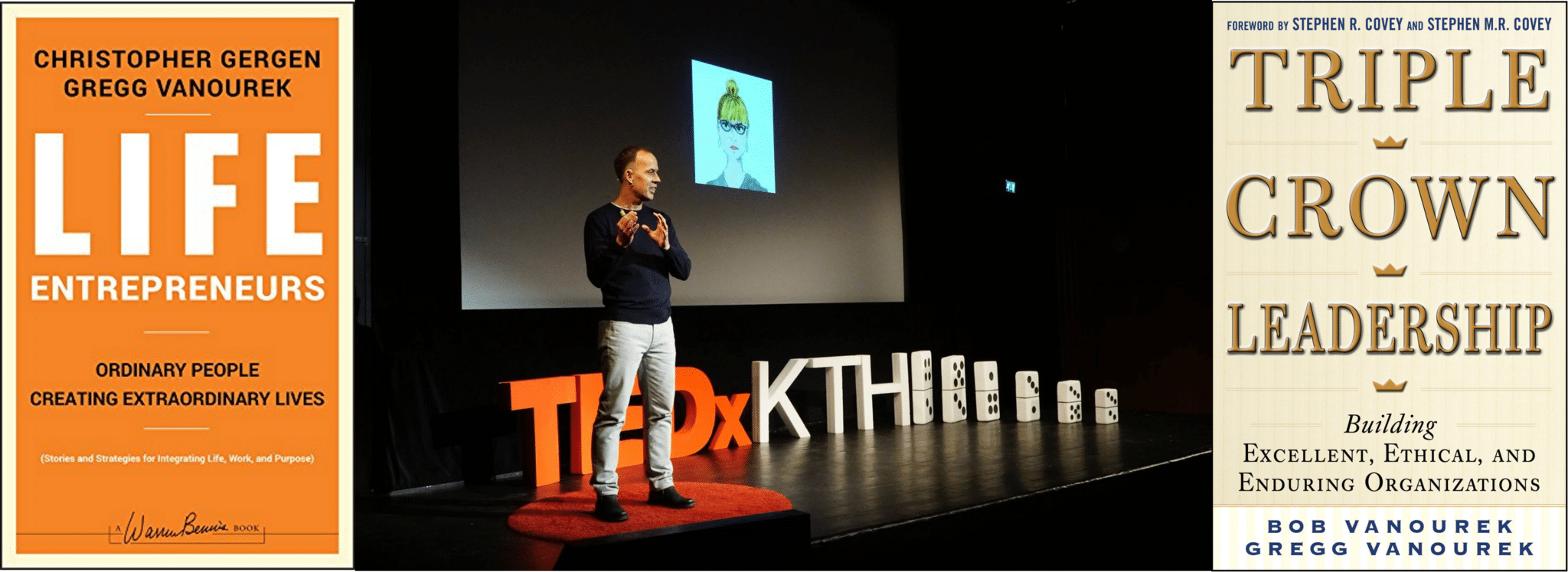
Gregg Vanourek is a writer, teacher, and TEDx speaker on leadership and personal development. He is co-author of three books, including Triple Crown Leadership: Building Excellent, Ethical, and Enduring Organizations (a winner of the International Book Awards written with his father, Bob Vanourek) and LIFE Entrepreneurs (a manifesto for living with purpose and passion, written with Christopher Gergen). He has worked for market-leading ventures and given talks or workshops in 8 countries. Check out his Leadership Derailers Assessment or join his growing community. If you found value in this, please forward it to a friend. Every little bit helps!