

Article Summary:
Too many leaders and teams avoid difficult conversations, defaulting to artificial harmony while real problems fester. This guide explores the essential role of productive conflict in leadership, showing you how to transform disagreement into a powerful tool for building trust and high-performing teams. It includes a Team Conflict Avoidance Quiz to help you assess your current culture.
+++
Does your team avoid conflict? Do team members engage in passionate debate—or sweep disagreements under the rug?
Navigating conflict can be uncomfortable. It’s just the way we’re wired.
The result? Teams sidestep tough issues and postpone difficult conversations. They default to preserving artificial harmony instead of dealing with what’s broken.
People walk on eggshells. Problems fester.
Conflict avoidance is very common in teams and organizations, and it’s causing grave damage.
“Conflict aversion is the organizational bubonic plague of our times.”
-Gus Lee with Diane Elliott-Lee, Courage: The Backbone of Leadership
That’s a shame because conflict isn’t the enemy of good relationships or effective teams. In fact, it can be essential to both—but only when managed well.
For leaders and teams (and for spouses, siblings, and friends), the question isn’t whether conflict will arise, but whether you’ll have the courage and emotional maturity to engage with it constructively. Learning to lean into disagreement in service of larger aims is one of the most important leadership skills you can develop.
Why Is Conflict So Hard?
When you’ve avoiding conflict, no doubt fear is a key driver. You may worry about creating tension or causing pain—or about being seen as a troublemaker or rejected.
Perhaps you’re worried about damaging relationships. Or potential retaliation. Ultimately, you’re probably wary of the unknown consequences that might follow.
Team Conflict Avoidance Quiz
How do you know if your team is struggling with conflict avoidance? The signs aren’t always obvious. What looks like harmony might actually be silence. And what feels like agreement might just be resignation.
Use the quiz below to assess the extent to which conflict avoidance is a problem for your team. For each statement below, select the option that best reflects your team. (Scale: 1. This isn’t an issue for us, 2. This shows up now and then, 3. This happens often, 4. This is a persistent problem.)
Interpreting Your Results: Add up your scores from all 10 items. Your total will range from 10 to 40.
- 10-16: Low Conflict Avoidance. Your team appears comfortable engaging in healthy debate and addressing disagreements directly.
- 17-24: Moderate Conflict Avoidance. There are some warning signs that conflict avoidance is present on your team. Certain issues may be going unaddressed, or some people may be holding back.
- 25-32: High Conflict Avoidance. Conflict avoidance is significantly impacting your team’s effectiveness. Important conversations are likely being sidestepped, and unresolved tensions may be building beneath the surface.
- 33-40: Severe Conflict Avoidance. Conflict avoidance is an acute problem for your team. It’s preventing real problems from being solved and causing major frustration.
Action Items:
- Brainstorm ideas to improve in key problematic areas.
- Discuss them with your team.
- Develop an action plan with key commitments.
Different Types of Conflict
In his book, The Five Dysfunctions of a Team, Patrick Lencioni distinguishes between productive conflict (“the willingness to disagree, even passionately, when necessary”) and destructive fighting and politics (“conflict without trust… an attempt to manipulate others to win an argument regardless of the truth”).
He presents this on a continuum, with artificial harmony on one end and mean-spirited personal attacks on the other. See the image below.
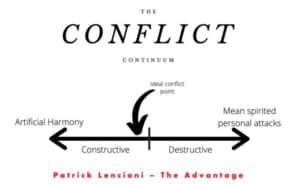
According to Lencioni, “most organizations live somewhere fairly close to the artificial harmony end of this continuum.” In other words, the problem more often than not is too little productive conflict, not too much unproductive conflict.
Of course, there are exceptions. In her book, Fierce Conversations, Susan Scott talks about “Machine Gun Nelly”—the kind of person who confronts others with “heavy artillery” (e.g., blistering verbal attacks or other bullying behavior).

A key distinguishing factor is intent. Productive conflict is about a genuine quest for group improvement, while unproductive conflict is about the infliction of harm, individual aggrandizement, or other selfish or destructive aims.
“…teams that engage in productive conflict know that the only purpose is to produce the best possible solution in the shortest period of time.” -Patrick Lencioni, The Five Dysfunctions of a Team
The Benefits of Productive Conflict
When handled constructively, conflict is a tremendous opportunity for growth and advancement. Leaning into productive conflict can transform your team’s dynamics and outcomes. Teams that embrace healthy conflict often find themselves:
- growing closer together
- solving problems more quickly and effectively
- building trust
- preventing destructive personal conflicts from festering
- making better decisions
- producing better results
By working through issues, they avoid letting tensions gather due to unresolved issues and hurt feelings. They avoid the frustration that comes with trying to solve the same problems over and over. Their problems don’t escalate or compound.
Most importantly, by regularly engaging in productive conflict in service of shared goals, they’re more likely to become a high-performing team.

How to Go About Orchestrating Productive Conflict
Creating an environment where productive conflict can thrive doesn’t happen by accident. It requires intentional effort and boatloads of trust. Here are 12 ways to foster constructive conflict:
1. Check your intent before engaging in conflict. (Scott, 2002)
When preparing for a difficult conversation, pause and examine your true motivation. Ask yourself: Am I speaking to solve a problem and strengthen this relationship, or am I speaking to punish, prove myself right, or settle a score? If you discover your intent is to wound rather than to heal, step back. Wait until you can approach the conversation from a place of genuine care for the outcome and the person.
If your intent is constructive, you can express your feelings honestly—even when you’re angry or frustrated—while still adding value. When people sense that your frustration comes from a place of caring about the work and the relationship, they’re more likely to register your anger without feeling attacked. Your forthrightness can even help build credibility and trust.
2. “Mine for conflict” in meetings. (Lencioni, 2002)
Think of yourself as a gold miner. Instead of digging deep into the earth to extract a precious metal, focus on drawing out important disagreements and buried tensions within your team. Raise sensitive issues. Encourage team members to work through them—and don’t let them do it halfheartedly or give up halfway. Productive conflict, like gold, is rare and valuable.
“Leaders do not avoid, repress, or deny conflict, but rather see it as an opportunity.”
-Warren Bennis, leadership scholar and author
3. Ensure every voice at the table is heard. (Scott, 2002)
As a leader, it’s your responsibility to notice who hasn’t yet contributed to the discussion and invite them in. This might mean pausing the conversation to ask Sarah for her take on the topic at hand or to ask Andrew if he sees any hidden risks or complications. When you make space for quieter team members, you often surface valuable insights that would otherwise remain hidden, and you signal that everyone’s input matters.
4. Actively seek out and explore opposing viewpoints. (Scott, 2002)
Don’t just accept the first consensus or the loudest voices in the room. Invite alternative perspectives. Ask for a different take. When someone offers a fresh or contrasting view, lean into it with curiosity. Probe deeper with follow-up questions. Demonstrate intellectual humility and open-mindedness.
5. Regulate the heat. (Heifetz, Linsky, and Grashow, 2009)
When sparks fly during meetings and people are starting to feel the heat, resist the urge to artificially cool things down just because people feel uncomfortable. Instead, keep the temperature hot enough for productive disagreement to continue. But not too hot. (No fire-bombing allowed.) Let your team work through tension and keep searching for solutions together. This is where the best work gets done.
6. Orchestrate the conflict. (Heifetz, Linsky, and Grashow, 2009)
Make sure the conflict stays focused on the issues and the work at hand. Search for the underlying competing values and perspectives that are blocking progress. The aim is to help people engage across their differences in ways that generate learning and movement toward solutions, not venting or avoidance. Conduct the meeting such that people build on each other’s points and keep moving forward toward clarity and insight.

7. Depersonalize conflict.
Shift attention from individual wins to mutual understanding. Keep the focus on your organization’s shared purpose, values, and vision. The key is to keep everything focused on shared goals and not on individual agendas. On the issues, not people or personalities. And on what’s best, not who’s right or who’s winning. When a teammate challenges someone in a high-performing team with real trust, it’s because they care about the team’s success.
8. Avoid the temptation to use praise as a precursor to confrontation. (Scott, 2002)
When you need to confront an issue or deliver critical feedback, don’t dilute it by leading with excessive praise. Doing so only trains people to brace for bad news whenever they hear compliments, and it can undermine the power of your genuine appreciation.
More importantly, it muddies the message you’re trying to send. Save your praise for moments when you truly want to recognize someone’s contributions—not for buffering difficult conversations. People in high-performing teams can be clear and direct with each other. They value honesty and forthrightness as long as it’s respectful and comes with positive intent.
“…sometimes we put so many pillows around a message that the message gets lost altogether…. Replace pillows with clear requests…. While we often tell ourselves we are softening the message so as not to hurt someone else’s feelings, we are really trying to protect ourselves.” -Susan Scott, Fierce Conversations
9. Praise their willingness to challenge each other when you see it. (Lencioni, 2012)
When you see your team start to disagree during a meeting, pause the discussion briefly to note that their willingness to challenge each other is valuable and productive, reinforcing it as a desired behavior. People are often relieved to hear that they’re helping the team, not hurting it, by engaging in this kind of passionate conversation.
10. Make productive conflict an explicit team norm.
Discuss the challenges of conflict avoidance with your team. Develop a clear written commitment that expresses how you approach conflict. Then remind people regularly and follow up. People in high-performing teams coach each other not to retreat from healthy debate. When team members notice someone pulling back from productive disagreement, they speak up. Over time, this mutual accountability builds a strong team culture and normalizes healthy conflict.
11. Drive to clear agreements and closure at the end of meetings.
Don’t let meetings end without clarity on decisions and specific action items: Who will do what by when? Be sure to reserve adequate time for this critical final step to ensure everyone understands the commitments made. Too many meetings end without clarity and closure, leading to misalignment and frustration.
12. Be mindful of the “emotional wake” that can come with conflict. (Scott, 2002)
In Fierce Conversations, Susan Scott notes that “everything you say creates an emotional wake.” You’re leaving an emotional impression that influences how people feel, think, and behave going forward. This can happen without your awareness, so it’s important to check in with others about how things are landing.
You’re responsible for the wake you create—whether it leaves people feeling energized and valued or diminished and defensive. Remembering this can help you be more intentional about how you communicate.
Conclusion
While most teams are out there avoiding conflict like the plague, you can use it to build a high-performing team and generate amazing results. But be mindful of that fact that most people will never become entirely comfortable with conflict. That’s okay. What matters is pushing through that discomfort and engaging anyway. A sign of effective leadership and true teamwork.
Wishing you well with it.
–Gregg Vanourek

Tools for You
- Leadership Derailers Assessment to help you identify what’s inhibiting your leadership effectiveness
- Personal Values Exercise to help you determine and clarify what’s most important to you
- Alignment Scorecard to help you assess your organization’s level of alignment
Related Articles & Resources
- “Why Conflict Is Good—And How to Manage It”
- Thomas-Kilmann Conflict Mode Instrument (a tool that measures your behavior in conflict situations)
Related Books & Sources
- Ronald A. Heifetz, Marty Linsky, and Alexander Grashow, The Practice of Adaptive Leadership: Tools and Tactics for Changing Your Organization and the World (Harvard Business Press, 2009)
- Robert Kegan and Lisa Laskow Lahey, An Everyone Culture: Becoming a Deliberately Developmental Organization (Harvard Business Review Press, 2016)
- Patrick Lencioni, The Advantage: Why Organizational Health Trumps Everything Else in Business (Jossey Bass, 2012)
- Patrick Lencioni, The Five Dysfunctions of a Team: A Leadership Fable (Jossey Bass, 2002)
- Kerry Patterson, Joseph Grenny, Ron McMillan, and Al Switzler, Crucial Conversations: Tools for Talking When Stakes Are High, 3rd edition (McGraw Hill, 2002)
- Kim Scott, Radical Candor: Be a Kick-Ass Boss Without Losing Your Humanity (St. Martin’s Press, 2019)
- Susan Scott, Fierce Conversations: Achieving Success at Work and in Life, One Conversation at a Time (Viking Penguin, 2002)
Postscript: Quotations on Conflict
- “In my work with leaders and their teams, I’ve discovered that a universal talent is the ability to avoid conversations about attitude, behavior, or poor performance.” -Susan Scott, Fierce Conversations: Achieving Success at Work and in Life, One Conversation at a Time
- “Overcoming the tendency to run from discomfort is one of the most important requirements for any leadership team—in fact, for any leader.” -Patrick Lencioni, The Advantage
- “For good ideas and true innovation, you need human interaction, conflict, argument, debate.” -Margaret Heffernan, entrepreneur
- “Successful leaders manage conflict; they don’t shy away from it or suppress it but see it as an engine of creativity and innovation. Some of the most creative ideas come out of people in conflict remaining in conversation with one another rather than flying into their own corners or staking out entrenched positions. The challenge for leaders is to develop structures and processes in which such conflicts can be orchestrated productively.” -Ronald Heifetz and Marty Linsky
- “When there is trust, conflict becomes nothing but the pursuit of truth, an attempt to find the best possible answer.” -Patrick Lencioni, The Advantage: Why Organizational Health Trumps Everything Else In Business
- “All great relationships, the ones that last over time, require productive conflict to grow.” -Patrick Lencioni, The Five Dysfunctions of a Team
Appendix: Appropriate Times to Avoid or Accommodate
While the bigger problem in most organizations and teams is conflict avoidance, that doesn’t mean there aren’t strategic times to avoid or accommodate. For example, if there’s no chance of making a change, fighting for something is futile. When the matter is minor, it may be wise to let it slide. (Yes, you can pick your battles.) If the person you’re with is fuming mad, you may want to let things cool down before engaging.
Of course, there are times when you may not have all the needed information, or when other people are better suited to resolve the situation. You should be careful, though, not to let these become excuses to become passive of conflict-avoidant.

+++++++++++++++++++++++
Gregg Vanourek is a writer, teacher, and TEDx speaker on leadership and personal development. He is co-author of three books, including Triple Crown Leadership: Building Excellent, Ethical, and Enduring Organizations (a winner of the International Book Awards written with his father, Bob Vanourek) and LIFE Entrepreneurs (a manifesto for living with purpose and passion). He has worked for market-leading ventures and given talks or workshops in 8 countries. Check out his Leadership Derailers Assessment or join his growing community. If you found value in this, please forward it to a friend. Every little bit helps!